Wednesday, June 29, 2022

Cathryn Ashbrook EDUC 538 - Reflection Blog Post #2


Briefly describe the website or tool and how it connects to the topic (TLC) in our course.

BrainPOP Jr. Movie of the Week Review for Teachers | Common Sense Education

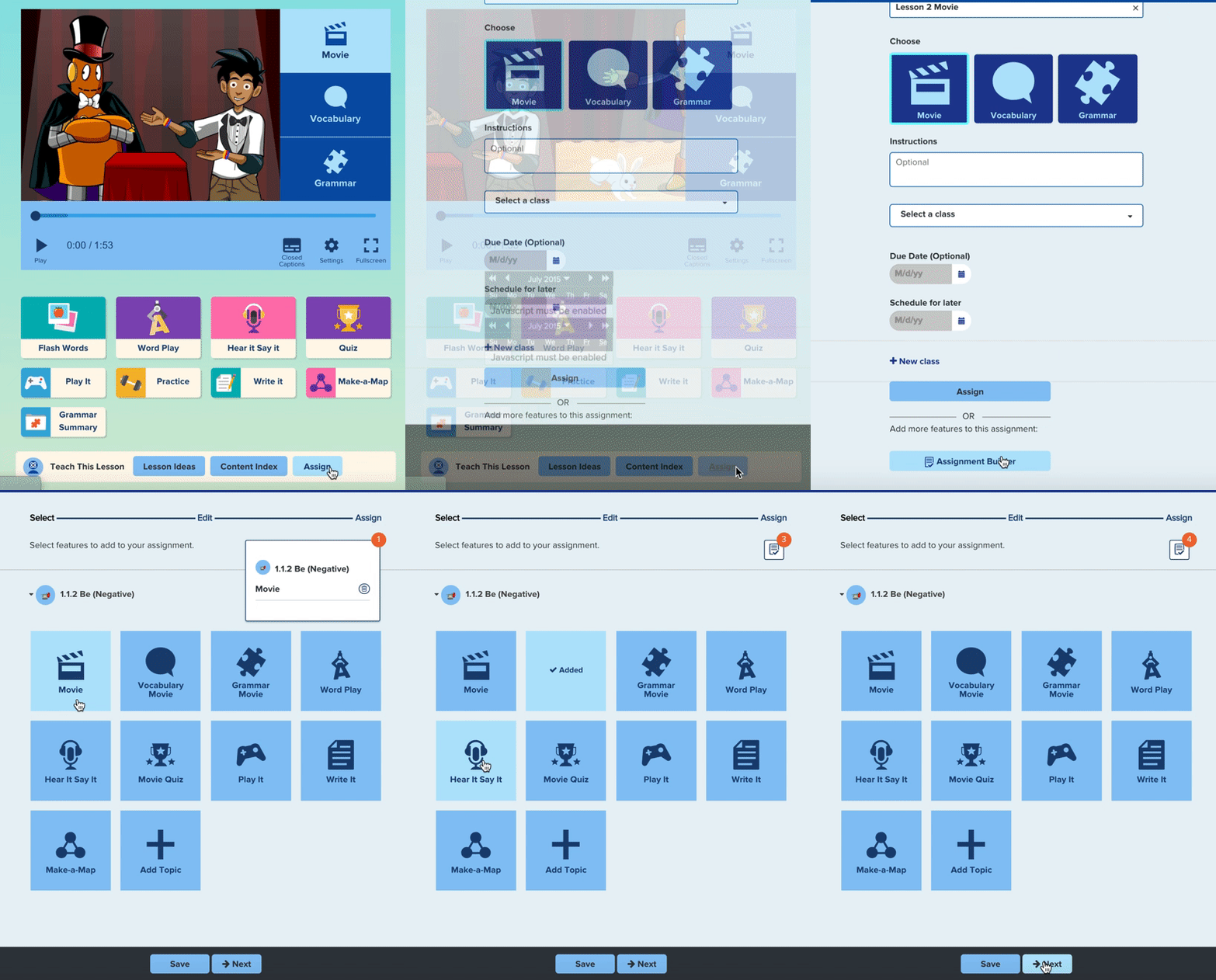
The learning tool I chose for this blog is BrainPOP. Brain Pop is a website for grades k - 8+ and it provides additional resources on numerous subjects taught in the classroom. Some subjects Brain Pop covers are science, math, social studies, and many more. This reference was found under the assessment category in our Teaching: Planning, Assessing, Instructing Tools PDF file. It connects to the teaching tools we have been discussing in TLC because it provides fun, interactive quizzes and games to assess students knowledge in a certain subject. I would also argue that this link could also apply in the instructing category as well. Every unit in Brain Pop has an informational video, vocabulary practice, and additional activities that enhances and dives deeper in a lesson. 


New! Assignments on ELL | BrainPOP Educators

Discuss each of these criteria: ease of use, versatility, and overall likelihood of using it in your classroom or professional situation.

Brain Pop is an incredibly easy website to navigate. That is one of the reasons why I like it so much! I feel comfortable will the ease of use that I am not overwhelmed or confused. This web tool is also one that I would have no issues with providing the students and their families with my login to access it on their own time. None of my personal information would be revealed and my families would receive a wonderful resource. Brain Pop is also student friendly and safe so if the students wanted to do their own exploring and research they could. I will very much use this resource in my future classroom! It will be a fun way to introduce new topics and to review the content with the students. 

BrainPOP Reading Round-Up | BrainPOP Educators


Ps: I tried to hyperlink the URL for Brain Pop but if it doesn't work here this the link! https://www.brainpop.com/


Tuesday, June 28, 2022

Cathryn Ashbrook EDUC 538 - Reflection Blog Post #1


Reflection Blog Post #1: Media Literacy

Explain your feelings after this first week of class and establish one learning goal for the course.

I am feeling a little overwhelmed after this first week of class. There are some aspects like making our own classroom website that I am still uncertain about. Luckily we have a check in with our professor later this week so I will be able to ask my questions! One learning goal I have for this course is to be more confident in my technology abilities. I have been fortunate and not had to experience online learning yet so any resources to make this transition easier, the better!

Describe your initial thoughts about the tool, Slack. Do you see how it could be used in your own teaching practice? How might you use it, or why might you not use it?

I like Slack! I find it a great way to get information out to everyone or to a certain group of people. I do not see myself using Slack in my teaching practice however at least not for this upcoming school year. The school that I will be teaching at is very "old school" and I do not see my fellow colleagues wanting to make this shift to a new resource. Everyone at this school seems to be set in their ways and I have a feeling I will be spending this year not trying to step on anyones toes. Even though I like all the features of Slack, it seems to me, everything I can do in Slack, I can do in an email. 

Share one question or concern you have about the class.

One concern I have about this class is the few times we met. I am afraid that I will not understand an assignment through reading the instructions but I know I will have the Slack access to ask any questions I have. 

breathe in... breathe out... - Happy Squirrel | Make a Meme

Thursday, August 12, 2021

EDUC 510 Module 4 Blog

 1. What do you envision "grading" looking like in your classroom?

I envision my grading in my future classroom to be standards based but also have a little bit of performance grading tied in. I love the idea of being able to grade multiple components. Its extremely important to have our students graded on the core standards since that is the foundation of our education, however its also important for students and parents to know how their child is performing and behaving in class. As we have discussed multiple times throughout this quarter, education and school is so much more than just learning academics, there are social and behavioral skills that also taking place. Using multiple grading allows me as a teacher to look at my students holistically instead of judging them from a narrow report. It also provides great data for myself and student's future teachers. 

2.  How do you intend to report out to students and their families?

I intend to report out to my students and their families by both physical and electronic reporting. I am hoping by doing both forms of communication I can reach everyone. I know some parents never check emails or give the schools an email that is no long active and I know some parents never empty out backpacks. When doing physical reporting such as papers going home, I would like to be efficient enough where everything goes home on a constant day. For instance, every Monday, this weeks papers go out, that way parents are expecting it.  I also intend to be a present face to all my families, if they would like to come in after school to talk or create a meeting time that works for both of us, I am willing to try anything. 

3.  What big takeaways from this week stand out to you?

A huge take away for me from this week is how complicated grading is going to be. Obviously not every student is the same, so figuring out how to fairly grade everyone will be interesting. I am also curious about my future classroom. What would I do if I teach at a school that has a grading system in place that I don't agree with?

Homework was another big takeaway for me this week. I was surprised to see how low of a number homework is suppose to be for each grade! I wish my schools followed that criteria more closely! However, when discussing homework, it really solidified the lack of benefits it actually has. I honestly think going forward in my future class, I'll create more time in my lesson plans to practice more in class and bring less home. If my students are to bring anything home, its to share with their families or to be an extra resource but never required to come back to me for a grade. 

Thursday, August 5, 2021

EDUC 510 Module 3 Blog

 1. What challenges do you anticipate in meeting the needs of individual learners?

One challenge I anticipate in meeting the needs of individual learners is incorporating all my students into the curriculum. I am anticipating there being a huge variety of interests and advancements or areas of struggle that I am afraid I will focus on one need and leave another area lacking of my attention. I am afraid that there is only one of me and I wont be able to get to my students needs in a timely manner. 

2.  What is your plan for meeting individual student needs?

I have a couple of ideas that I think will get me in the right direction. The first idea for meeting individual student needs is to take the time in the beginning of the year (and throughout) to learn what interests my students. Once I figure that out, it will be easier for me to make my class content match what my students are into. The second idea I have is to almost rotate through different methods that meet my students needs. For example, if a few of my students need more visual instructions instead of auditory instructions I can provide a video or powerpoint on how to get the task at hand done. 

3.  What resources can you utilize to help meet the needs of diverse learners?

A big resource I believe I can use is my colleagues. They might have had this particular student or have had experiences with meeting the needs of diverse learners before. My colleagues might be able to give me new techniques or methods to present my class content in a way I didn't think about. They could also help me revise my lesson plans by giving me advice on how to tweek certain aspects to make my lessons different or accommodating to specific learners. I also think another huge resource for me to help meet the needs of diverse learners will be research. Constantly looking for new methods that will help me engage my students or to even see if someone else has had these challenges and how they handled it. 

Monday, July 26, 2021

EDUC 510 Module 2 Blog

1. Was anything regarding this week's content that was surprising or new for you?  Explain.

This week was a nice learning experience, in my undergrad we discussed assessments but it was definitely something that was glossed over. I learned and finally solidified the difference between formative and summative assessment. Dr. Torres had a wonderful way of remembering the difference in her lectures by formative being FOR (during) the learning and summative being OF (after) the learning.  I was also surprised to learn that you can intend your assessment to be formative but then it is instead used as summative. I think this would happen when you are teaching a concept and when checking in with your students, you realize and have the proof, they are proficient and ready to move on. 

2.  What makes creating assessments so challenging?

There are two big challenges for me, the first, is the making sure my assessments are both reliable and valid. The second is making sure I ask the right type of questions in the right way. I could easily steer the students into a direction that doesn't measure or gather data related to the learning target. I also don't want to create assessments that are surface level and only pertain to the remember category of Bloom's Taxonomy. My goal is to gain more skill and proficiency at creating assessments that really illustrate my student's performance and intended learning objective. 

3.  Because quality assessments are so important-- what are the strategies you could implement to make creating the more manageable?

Keep my previously designed assessments. Every assessment will need to be adjusted depending on the overall class and years that go by but having previous templates would help me create assessments more proficiently. I will also be able to see what is right and wrong in my assessments from previous examples. I also think having a document with questions typed a certain way would help. That way when it comes to creating the assessments I can copy and paste and tweek my wording where needed. 


Thursday, July 22, 2021

EDUC 510 Module 1 Blog

1.  In your experience, how does assessment determine what a student learns and doesn't learn? 

 In my experience, assessments have been very surface level. They have only assessed that I know the stages in the water cycle but nothing further past that. For instance, how the water cycle pertains to stuff outside of academics. If a part of the water cycle doesn't happen, how detrimental it can be to corps and farmers. During my time as a recreation therapist, we used assessments to help guide us in what our patients were interested in. The issue was that it was so narrow that it didn't have options that interested my clients and it also didn't allow my clients to branch out and try new things; leaving certain aspects or hobbies unlearned. In my experience, the assessments we used tried to put everyone in a box that was unrealistic for what I was trying to teach my clients. 

2.  How does assessment relate to what is valued and what is not valued?  

Assessments are the driving focus of what is valued and not valued in education. If a concept is worth really knowing than some form of summative assessment will be conducted. If you can't connect how it relates to the students or create a reliable and valid assessment, it probably doesn't have to be taught. As stated above, knowing or what the stages of the water cycle was valuable, where as, the why or how behind it is considered invaluable. 

3.  In your classroom, what do you imagine is worth assessing and not worth assessing? 

In my perfect classroom, I imagine assessing the whys and hows of concepts. For instance, how is the four seasons important to our everyday living (ie: the snow from winter gives us water for summertime, it helps replenish our water sources, etc.) I am more interested in the connections of how things relate from our academics to our everyday world. Yes, its important to know the fundamentals such as color names and the stages of the water cycle but it is not worth assessing only the what of a concept. I would also like to incorporate more affective and psychmotor domains into my assessments. I personally believe that including those two aspects will help make the class content more relevant and meaningful to the students.